


Le recouvert EN • Fully Upholstering a pouf
CO-LINGUAL COURSE
Upholstery of a piece of furniture
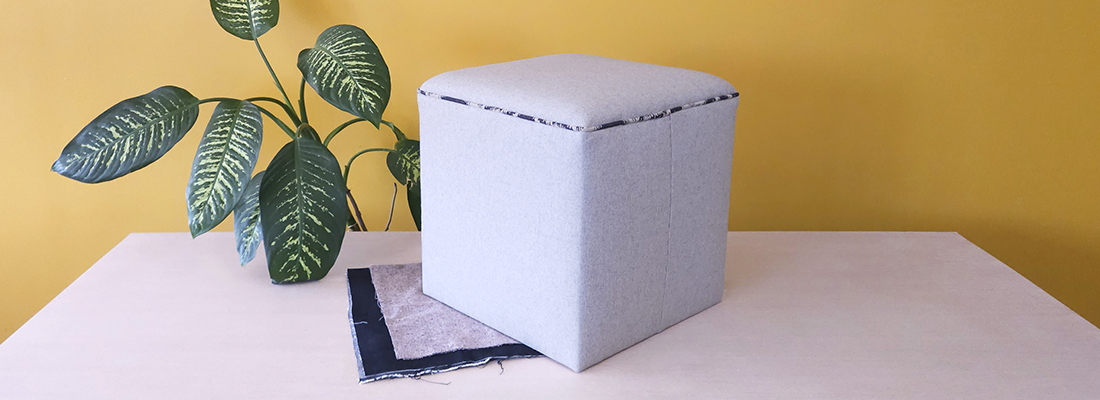
This class provides step-by-step guidance through all the steps required to fully upholster a pouf with the fabric of your choice. You’ll practice these techniques in the workshop, with a special focus on finishing touches to ensure a neat and uniform result. At the end of the class, you’ll leave with a pouf you’ve made entirely by hand, ready to be incorporated into your home decor.
PLEASE NOTE: This course is co-lingual (French–English), which means that francophone and anglophone participants form a single group and attend the same classes. The trainer adjusts the language of teaching to accommodate the group or alternates between French and English. All participants may speak the language of their choice, and the trainer will make sure that everyone understands the content.
It is not necessary to be bilingual to register, but basic understanding of both languages may be helpful. Because this course is based on manual work and individual exploration, it is particularly well suited to this way of working. We consider linguistic diversity an asset, and we ask that you show inclusiveness, kindness, and respect.
Prerequisites for the course
Level 1 – No prerequisites
Number of sessions
1 session
Training duration
6 hours
Cost
340 $ + txs
Complete upholstery course in pictures

Schedule
Group 1
Saturday, April 3, 2027, 9 AM to 4 PM
These dates don’t work for you? Find a course that fits your schedule.
Answers to frequently asked questions about full furniture upholstery
What tools are needed to get started with upholstery?
Upholstery involves using various tools to precisely cut, assemble, and secure foam, fabric, and decorative elements, while ensuring a polished finish.
In Le recouvert EN course, you’ll use scissors, an electric knife, a pneumatic stapler, as well as needles and small tools to complete the various stages of production. We’ll also share our top supplier recommendations with you. This will help you build the foundation you need to properly equip yourself and gain independence in your upholstery projects.
How do you make a piece of furniture that is fully upholstered and covered in fabric?
A fully upholstered piece of furniture rests on a sturdy wooden frame, designed to withstand the various stages of the upholstery process. This frame is then completely covered through a process that includes preparing the materials, shaping the padding, and applying the fabric, with particular attention paid to uniformity and the quality of the finish.
In the upholstery course, you will create a fully upholstered square pouf using a frame provided by ÉÉAM. You will experience every step of the process and develop a practical understanding of full upholstery by crafting a custom pouf with a polished finish.
How can I achieve a professional finish when upholstering?
With fully upholstered furniture, every detail is visible, which makes the finishing process particularly delicate. A professional finish therefore relies on mastery of precise techniques that ensure clean lines, discreet seams, and long-lasting durability.
In this course, our expert instructors will teach you the essential techniques: applying the interlining, adding seamless piping, hand-finishing, and integrating a finishing fabric onto the base. These skills will enable you to create a pouf with a polished, durable, and professional look.
Course plan
- Scissors
- Electric fabric cutter
- Pneumatic stapler
- Needles and small tools
- Create cushion form with foam and polyester batting
- Laying fabric
- Use of cardboard tack strip
- Applying seamless piping
- Finishing with hand stitching
- The wooden frame of the ottoman, as well as the materials and tools needed to carry out the exercises and/or projects.
- Course notebook
- If necessary, loan of hearing protectors and safety glasses
IMPORTANT : Each participant must bring their own choice of upholstery fabric (1,5 metre). This fabric should :
- Ideally have a resistance of minimum 25 000 double rubs.
- Have a solid color that doesn’t change in appearance depending on direction (avoid patterned fabrics).
- Be of medium thickness; avoid thick fabrics.
Shops like C&M Textiles and Fabricville have staff that will be able to advise. There are also numerous fabric shops on the rue St-Hubert that have an extensive upholstery section.
The project calls for participants to create their own piping using the same fabric as the entire pouffe. For contrasting or store-bought piping, contact the École.
If you have one, you can bring:
- a dust mask
- hearing protectors
- safety glasses
- safety shoes
Schedule for the full upholstery course
- Introduction, course objectives and project
- Size of foam and polyester
- Form the seat (give shape by stapling the polyester over the foam, to the frame) and lay the fabric on the top of ottoman
- Place piping with staples
- Place fabric strip with cardboard tacking strip
- Traditional hand-stitch finishing
- Arrange final fabric on the base
Participants
Unless otherwise specified, ÉÉAM general public courses are only open to people 18 years of age and older.
As openness and inclusion are essential values for the ÉÉAM, the school strives to accommodate everyone who is interested in cabinetmaking. If you live with a functional limitation and have questions regarding your ability to attend training, please contact us to discuss.
